

What Buyers Should Verify in a China Vibration Damping Pads Supplier: Changmei Technology’s CNAS‑Certified Testing

Material and Thickness Must Match the Installation Interface
For metro track-bed applications, microcellular polyurethane damping pads can be installed between the track bed and foundation in full-surface, strip, or spot layouts. The product platform supports both cast-in-place construction and prefabricated slab workflows, so pad dimensions, stiffness, and placement need to match the actual track-bed geometry rather than a single assumed slab format.
Beyond rail track beds, Changmei Technology’s polyurethane isolation portfolio covers building-foundation isolation, impact-noise control in floor systems, room-in-room structures with isolated floors and walls, and industrial equipment vibration isolation. This broader application range means the correct pad grade and parameter set must be selected for the load, support condition, vibration source, and construction interface of each project.
For building and industrial applications, the required parameter window can differ substantially from the rail values above. Building-foundation pads can act as plane bearings beneath cast-in-place concrete slabs, floor products use thinner microcellular polyurethane layers for impact-noise control, and industrial-equipment pads are selected around machine loads and foundation vibration. Buyers should therefore compare application-specific data rather than carrying the 25–35 mm rail specification into every use case.
Foundation Modulus and Natural Frequency Define the Rail Isolation Target
For the metro floating-slab track-bed pad, a static foundation modulus of 0.01 N/mm³ and a natural frequency of ≤20 Hz translate the elastic layer into quantified system behavior. These values should be assessed together with slab mass, train-induced excitation, support layout, and the target frequency band for the rail project.
In a rail mass-spring system, the damping pad provides the elastic support while the track slab acts as the supported mass. Changing foundation modulus changes the vertical flexibility and therefore the system natural frequency, which is why the pad specification has to be coordinated with the track-bed design.
It is a common misconception that a lower natural frequency is universally better. In practice, project engineers must avoid any unfavorable overlap between the operational excitation frequency band of the rolling stock and the structural resonance zone of the track system. The pad must provide effective isolation while still retaining sufficient static support and geometric stability for the slab above.
Compression Set and Electrical Resistance Extend Rail-Specific Verification Beyond Vibration
For rail track-bed applications, long-term viability depends on resistance to permanent deformation as well as electrical isolation. Metrics such as a compression set of ≤10% and insulation resistance of 10⁸ Ω add acceptance dimensions beyond initial vibration attenuation for the metro floating-slab track-bed pad.
The compression set metric measures a material's ability to recover its original thickness after prolonged or repeated compression. A high permanent deformation rate will alter the elevation of the slab bottom and change the effective stiffness of the pad. Therefore, this metric must be evaluated in conjunction with the track's anticipated long-term cyclic loading.
For the metro track-bed pad, an insulation resistance of 10⁸ Ω integrates the elastic layer into the track’s electrical-isolation strategy. This rail-specific requirement should be assessed together with mechanical performance and project stray-current controls rather than transferred automatically to building or industrial pad grades.
Comprehensive Testing Extends Beyond Fatigue Life
Fatigue-life testing remains important because repeated dynamic loading can reveal changes in stiffness, deformation, or structural integrity over time. However, it is only one part of Changmei Technology’s in-house testing scope.
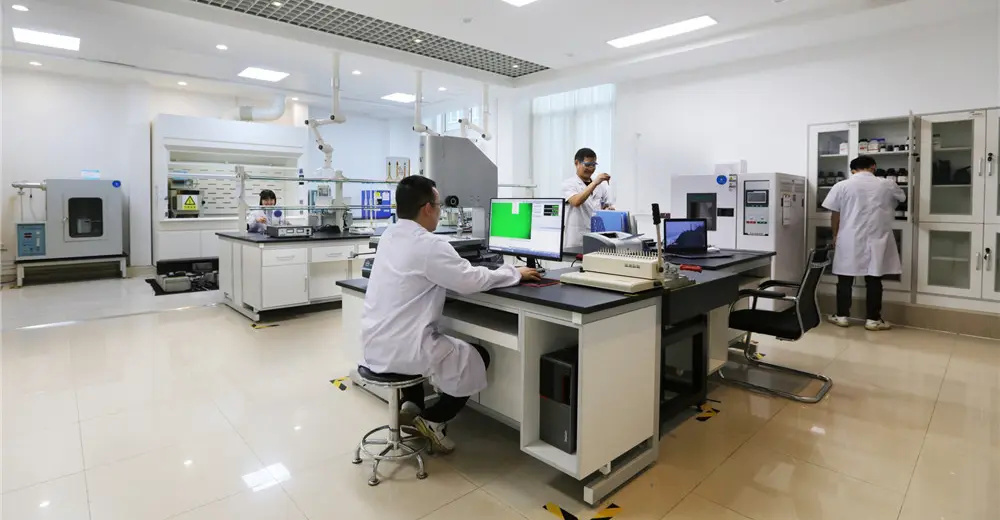
The CNAS-accredited Testing Center covers mechanical properties such as tensile and compression behavior; physical properties such as density and hardness; physicochemical and electrical properties; combustion, wear, and aging performance; fatigue-life simulation under dynamic loading; and application-specific finished-product validation. For buyers, this wider matrix provides a more complete basis for qualifying a pad than a fatigue-only result.
Project-specific qualification can combine the applicable material tests with finished-product testing and fatigue-life simulation. The relevant test set should correspond to the product family and intended service condition—for example, rail electrical insulation and cyclic loading, building acoustic and load performance, or industrial foundation loading and chemical exposure.
CNAS Accreditation Defines Laboratory Competence, Not Product Life by Itself
While CNAS accreditation serves as formal proof that a laboratory possesses the necessary testing capabilities and quality management systems within its recognized scope, it does not automatically equate to a certification of a specific vibration damping pad’s service life. Product conclusions must always be drawn from specific test conditions and the resulting data reports.
The testing scope of the Changmei Testing Center also includes tensile and compression testing, density and hardness measurements, electrical properties evaluation, aging and wear analysis, and application-specific finished-product validation. This breadth ensures that engineers have supplementary testing methods available to analyze various potential failure modes.
Although corporate resources such as laboratory floor space and a staff of over 30 testing personnel demonstrate substantial capacity, the true driver of procurement decisions is the technical alignment. Buyers must verify that the test methods, sample conditions, load spectra, acceptance criteria, and report traceability match the rigorous demands of their specific engineering files.
A Service Provider Should Connect Testing with Survey, Inspection and After-Sales
The true procurement value of a vibration damping pads service provider depends on how seamlessly they integrate testing with pre- and post-manufacturing engineering workflows. Changmei Technology links initial site surveys, joint technical validation, prototype testing, critical-stage inspection reports, and on-site installation guidance into a unified project service chain.
Initial surveys and parameter validation identify the relevant load, vibration source, support geometry, and environmental conditions. For rail projects this includes track-bed and alignment data; for building or industrial projects it shifts to foundation, floor or room, or machine-interface conditions. Prototype testing and critical-stage inspection then lock the configuration before bulk production and installation support.
Furthermore, the company establishes clear time boundaries for post-delivery technical support, committing to a 2-hour response time and a 24-hour resolution plan for technical issues. Procurement teams that evaluate CNAS-accredited comprehensive testing alongside upfront parameter confirmation, process documentation, and rapid after-sales response can more fully assess the engineering delivery capabilities of a vibration-damping pad service provider. For more information, visit https://www.changmeitech.com/.
Shaanxi Changmei Technology Co., Ltd.
Changmei Technology
email us here
Visit us on social media:
LinkedIn
Facebook
YouTube
TikTok
Legal Disclaimer:
EIN Presswire provides this news content "as is" without warranty of any kind. We do not accept any responsibility or liability for the accuracy, content, images, videos, licenses, completeness, legality, or reliability of the information contained in this article. If you have any complaints or copyright issues related to this article, kindly contact the author above.
